How to Describe the Shape of a Data Set
Data hardly ever fall into perfect patterns so you have to decide whether the data shape is close enough to be called symmetric. Dispersion how spread out the values are from the average.
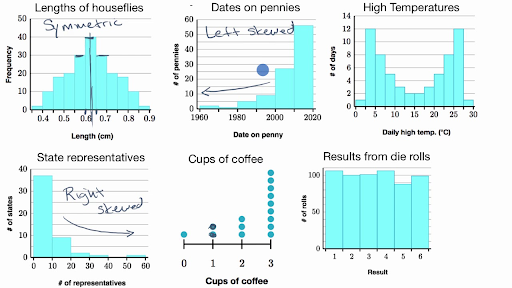
Classifying Shapes Of Distributions Video Khan Academy
A graphs symmetry can be described as being approximately symmetrical positively skewed or negatively skewed.

. The sample variance for a sample of n measurements is equal to the sum of the squared deviations from the mean divided by n - 1. A distribution that is not symmetric must have values that tend to be more spread out on one side than on the other. Visually we see the histogram has 4 bars.
This set is normally presented in a tabular pattern. Shape the data distribution which relates to how evenly the values are spread either side of the. To begin with the data must be divided into equal categories.
Mean median and occasionally mode. The shape property returns a tuple representing the dimensionality of the DataFrame. Here is how to graphically plot out the data to find its shape.
Every column describes a particular variable. A graph with a single peak is called unimodal. Centrality the middle value or average.
This is a part of data management. The halfway point of the histogram is between the. In this tutorial we will learn how to get the shape in other words number of rows and number of columns in the DataFrame with the help of examples.
The most common real-life example of this type of distribution is the normal distribution. Shape of the distribution. In this case we say that the distribution is skewed.
When describing the shape of a distribution one should consider. More bars are towards left or right respectively which can. The mean and median are less than the mode.
Knowledge of the datas variability along with its center can help us visualize the shape of a data set as well as its extreme values. Lesson Standard - CCSS6SPA2. The categories must have equal intervals to make the data meaningful.
Figure 47 a Skewed to the left left-skewed. When examining the distribution of a quantitative variable one should describe the overall pattern of the data shape center spread and any deviations from the pattern outliers. Center spread and shape of distributions are also known as summary statistics or statistics for short.
Check the skewness in the data whether it is left skewed or right skewed ie. And each row corresponds to a given member of the data set as per the given question. The SAT covers three measures of center.
Describe the distribution of the set as left-skewed right-skewed symmetric or no pattern. Symmetric graphs are found when the left and right side from the median of the graph mirror each other. To get the shape of Pandas DataFrame use DataFrameshape.
The format of shape would be rows columns. Describes the peakedness in a curve and the thickness of the tails Occurs in normally distributed data sets Bell curves Leptokurtic Tall and skinny compared to the Normal bell curve with an excess of extreme values causing the tails to be thicker than the. There are four different ways in which we can describe a graphs shape.
Replication how many values there are in the sample. Symmetrical These are usually bell shaped or normally distributed. Uniform A histogram is described as uniform if every value in a dataset occurs roughly the same number of times.
Otherwise you classify the data as non-symmetric. Plot Data into Categories. Skewness is a measure of the asymmetry of the probability distribution of a real-valued random variable about its mean.
Graphs that contain peaks of data can be labeled as either unimodal distributions one peak or bimodal distributions two peaks. The skewness value can be positive or negative or undefined. Bell-Shaped A histogram is bell-shaped if it resembles a bell curve and has one single peak in the middle of the distribution.
Dont assume that data are skewed if the shape is non-symmetric. This video describes the 4 shapes a distribution of a data set may take and how the mean and median are related for every shape. Shape The shape of a histogram can indicate whether there is a tendency for some data values to occur more than others or not.
Check in which region the data is concentrated more or the region in which there is little to no values. Then a frequency table must be prepared from the available data set and the number of times an item occurs within an interval category must be. They concisely describe data sets.
Spread describes the variation of the data. In this lesson you will learn about the shape of the distribution of data by looking at various graphs and observing symmetry bell curves and skews. We want to describe the general.
Center describes a typical value of in a data set. For a unimodal distribution negative skew commonly indicates that the tail is on the left side of the distribution and positive skew indicates. Understand that a set of data collected to answer a statistical question has a distribution which can be described by its center spread and overall shape.
If the differences arent significant enough you can classify it as symmetric or roughly symmetric. The four ways to describe shape are whether it is symmetric how many peaks it has if it is skewed to the left or right and whether it is uniform. A Dataset is a set or collection of data.
Data sets describe values for each variable for unknown quantities such. There are four key areas to consider when summarizing a set of numbers.

Activity For Describing Distributions Of Univariate Data In Ap Statistics Ap Statistics High School Math Classroom High School Math

Histogram Terminology Data Science Histogram Data Science Statistics
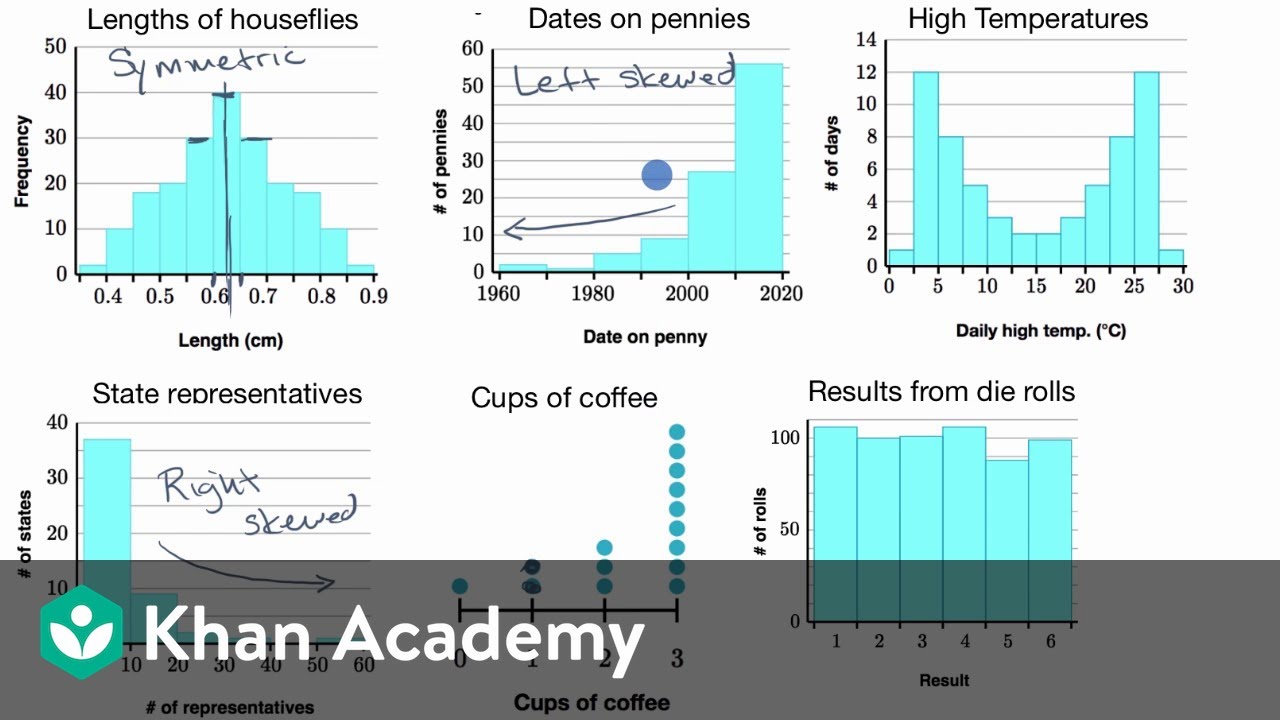
Classifying Shapes Of Distributions Video Khan Academy
Shape Of Data Distribution Mini Word Wall Word Wall Math Word Walls Data Distribution


Comments
Post a Comment